An AI governance audit is a structured review of how an organization controls, documents, monitors, and improves the use of artificial intelligence across its business. In 2026, the most valuable AI audit is no longer a one-time checklist. It is a repeatable operating model that connects AI inventory, risk classification, data governance, vendor oversight, human review, security controls, audit logs, compliance evidence, and remediation ownership.
AI Summary
Quick Answer
An AI governance audit checks whether an organization can prove that its AI systems are known, classified, controlled, monitored, and accountable. A strong audit covers AI policies, system inventory, data sources, model and vendor risks, human oversight, security, logging, compliance mapping, and an actionable remediation plan.
- Audit scope: This guide explains how to plan, run, and document an AI governance audit without turning the process into a generic compliance article.
- Core output: The audit should produce a risk-rated findings report, an evidence register, a remediation roadmap, and a repeatable review cadence.
- Main frameworks: Use the NIST AI Risk Management Framework, ISO/IEC 42001, EU AI Act readiness, ISO/IEC 23894, SOC 2 control overlap, and the OWASP Top 10 for LLM Applications.
- Most common gap: Companies often use AI before they have a complete AI inventory, documented system owners, approved data flows, vendor reviews, prompt/version control, incident procedures, or audit trails.
- Cost driver: AI audit cost depends on the number of AI systems, risk level, data sensitivity, regulatory exposure, vendor complexity, evidence maturity, and whether the audit includes technical testing or only governance review.
What Is an AI Governance Audit?
An AI governance audit is a formal review of the policies, controls, evidence, and accountability mechanisms used to manage artificial intelligence systems. It asks a practical question: can the organization prove that its AI systems are safe enough, documented enough, monitored enough, and governed by the right people?
The audit usually covers the full AI lifecycle: business use case, system owner, data source, model or vendor, prompt design, output review, access control, user disclosure, security testing, monitoring, incident handling, and change management. For regulated or high-impact use cases, it also maps evidence against applicable frameworks and laws.
This is why AI governance auditing is broader than a technical model test. It is not only about whether a model performs well. It is about whether the business can explain, control, supervise, and improve the way AI is used.
Direct definition
An AI governance audit is a structured assessment of an organization’s AI systems, policies, risks, controls, documentation, monitoring, human oversight, vendor management, and compliance readiness.
Practical interpretation
If a company cannot list every AI system it uses, name the business owner, describe the data being processed, show the model or vendor dependency, prove review controls, and produce logs or evidence, it is not audit-ready.
Why AI Governance Audits Matter in 2026
AI has moved from experimental tools into production workflows, customer-facing software, internal decision support, search systems, support automation, hiring tools, code generation, analytics, and agentic workflows. That shift creates a governance gap: AI is often deployed faster than risk, legal, security, and compliance teams can document it.
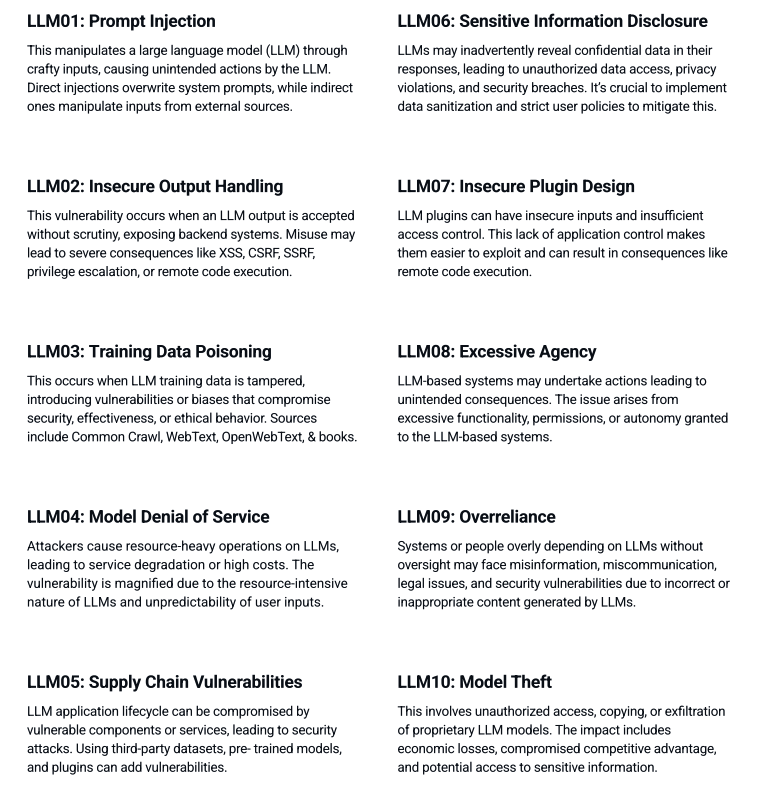
At the same time, external expectations are rising. The NIST AI RMF provides a voluntary framework for managing risks to individuals, organizations, and society. ISO/IEC 42001 defines requirements for an AI management system. The EU AI Act creates a risk-based legal framework for AI in the European Union. For AI systems using large language models, the OWASP Top 10 for LLM Applications highlights security risks such as prompt injection, sensitive information disclosure, supply chain vulnerabilities, and excessive agency.
For SEO and AI search, this page is built around clear definitions, answer-first sections, structured tables, and evidence-based sources. Google’s guidance for AI features says website owners should continue following Search Essentials, provide helpful content, make content accessible to Googlebot, use structured data when appropriate, and avoid blocking important resources from crawling in ways that prevent Search from understanding the page. See Google Search Central’s documentation on AI features and your website and its 2026 resource on optimizing for generative AI in Google Search.
Business reasons to audit AI governance
Companies run AI governance audits to reduce legal, security, operational, reputational, and customer trust risks. SaaS companies also use them to answer enterprise procurement questionnaires, support security reviews, strengthen sales conversations, and prepare for future certification or compliance requirements.
AI Governance Audit vs. AI Audit vs. LLM Audit
The search terms AI audit, AI auditing, audit AI, AI governance assessment, and AI governance auditing are often used interchangeably. In practice, they describe different scopes. An AI governance assessment is usually a readiness review that identifies gaps in policies, ownership, documentation, and controls. A governance audit goes further by testing whether those controls are evidenced, repeatable, and owned by accountable teams. A model or LLM audit is narrower and usually tests the performance, safety, reliability, or security of a specific AI system.
| Audit type | How it differs |
|---|---|
| AI Governance Audit | Focus: policies, accountability, lifecycle controls, evidence and remediation ownership. Typical evidence: AI inventory, risk register, governance policies, approval logs and control mapping. Best owner: risk, compliance, security or executive operations. |
| AI Audit | Focus: broad review of AI systems, outputs, documentation and business use. Typical evidence: model documentation, system logs, vendor records and test results. Best owner: internal audit, technology leadership or risk management. |
| AI Compliance Audit | Focus: legal, regulatory and policy obligations for AI use. Typical evidence: regulatory mapping, risk classifications, disclosures, privacy records and documented controls. Best owner: legal, compliance or privacy teams. |
| LLM Performance Audit | Focus: answer quality, hallucination rates, latency, cost, benchmark performance and consistency. Typical evidence: evaluation sets, model comparison results, prompt versions and monitoring data. Best owner: product, engineering or machine learning teams. |
| AI Security Audit | Focus: access control, prompt injection, data leakage, excessive agency and model abuse. Typical evidence: security tests, access logs, red-team findings and remediation records. Best owner: security, engineering or application security teams. |
| AI Fairness Audit | Focus: bias, discrimination risk, disparate impact and inclusivity in AI outcomes. Typical evidence: fairness tests, sample reviews, model limitations and mitigation documentation. Best owner: risk, legal, HR, data science or compliance. |
Avoid scope confusion
Do not use one page, one project, or one audit report to cover every possible AI risk. AI governance auditing, AI search visibility, LLM performance, AI fairness, and cybersecurity overlap, but they are not the same audit scope. Mixing them without boundaries creates weak evidence and weak SEO intent.
Who Needs an AI Governance Audit?
Any organization using AI in a material business process can benefit from an AI governance audit. The need becomes more urgent when AI affects customers, employees, regulated decisions, sensitive data, external communications, financial outcomes, healthcare information, hiring workflows, credit decisions, insurance pricing, security operations, or autonomous actions. Once AI moves beyond experiments, corporate AI governance and enterprise AI governance need clear AI governance leadership, documented AI governance responsibilities, and named owners for every high-impact system.
SaaS companies
SaaS companies need AI governance audits when they add AI features to products, use AI for customer support, rely on AI for lead scoring or personalization, embed third-party models, or sell to enterprise buyers that ask for AI risk documentation.
Finance, banking, lending, and insurance
Financial firms need deeper audit evidence when AI or machine learning affects underwriting, fraud detection, customer segmentation, credit recommendations, pricing, claims processing, or compliance monitoring. For finance, banking, and lending teams, auditing AI and machine learning models used in loan underwriting requires governance risk controls for bias, explainability, data quality, approval workflows, monitoring, and human review.
Healthcare and life sciences
Healthcare organizations should audit AI systems used in clinical decision support, patient communication, coding, triage, scheduling, claims, medical device software, or protected health information workflows.
HR, recruiting, and workforce tools
HR and recruiting tools need governance review when AI affects candidate ranking, interview scheduling, job matching, performance analysis, workforce planning, or employee monitoring. This is also where AI fairness audit and AI bias audit questions become important.
Public sector and government contractors
Public agencies and government vendors need strong documentation for AI procurement, security, privacy, risk classification, accessibility, records retention, and accountability. Searches around government audit deficiencies, AI security, and material weaknesses point to the need for audit-ready evidence and formal control ownership.
When Should You Run an AI Governance Audit?
The best time to run an AI governance audit is before AI becomes business-critical. Waiting until an incident, regulator request, failed procurement review, or public controversy usually makes the audit harder and more expensive.
For teams with many AI use cases, an AI governance intake prioritization workflow helps decide which systems need full audit depth first. Prioritize customer-facing, regulated, autonomous, sensitive-data, and revenue-critical AI systems before low-risk internal experiments.
| Trigger | Recommended Audit Response |
|---|---|
| Launching a new AI product feature | Run a pre-launch governance review covering use case, data, model, human oversight, disclosures, monitoring, and incident response. |
| Preparing for enterprise procurement | Prepare evidence for AI policies, vendor reviews, data processing, security controls, model limitations, and audit logs. |
| Using AI in a regulated workflow | Perform risk classification, compliance mapping, legal review, fairness checks, documentation review, and approval workflow testing. |
| Adding AI agents or autonomous actions | Audit tool access, permissions, transaction limits, rollback controls, approval gates, memory, logs, and escalation paths. |
| Changing models, vendors, or data sources | Review change management, regression tests, vendor risk, data governance, and model documentation before deployment. |
| After an AI incident | Run a post-incident governance audit focused on root cause, control failures, logs, escalation timing, remediation, and residual risk. |
What Does an AI Governance Audit Cover?
A deep AI governance audit covers both management controls and technical evidence. It should not stop at a policy review. The auditor should be able to trace each AI system from business purpose to data source, model or vendor, output use, human oversight, logs, and risk treatment.
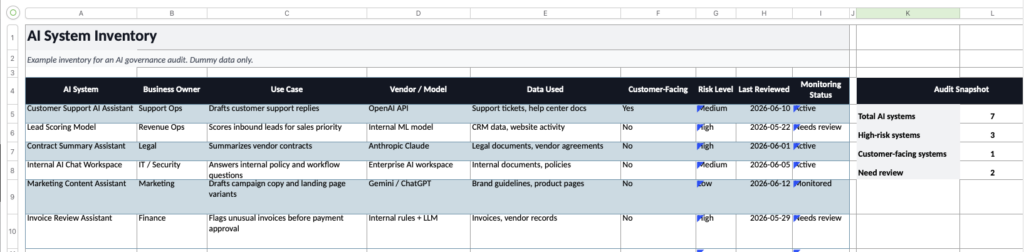
AI system inventory
The audit begins with a complete AI inventory. Each system should have a name, owner, business purpose, users, data categories, model or vendor, deployment environment, risk classification, customer impact, and review date.
Risk classification
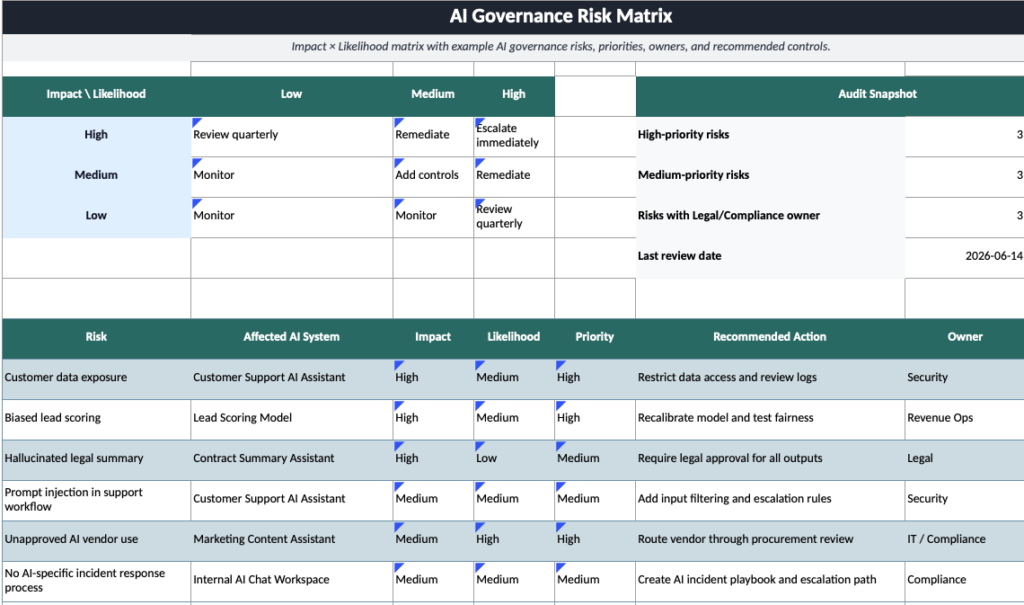
Every AI use case should be classified by potential harm, autonomy, data sensitivity, external exposure, regulatory relevance, and reversibility of decisions. A chatbot that summarizes public documentation has a different risk profile than a model affecting loan underwriting, hiring, insurance eligibility, or healthcare triage.
Data governance
AI data governance measurement and audit should cover data sources, lawful basis, consent, retention, access rights, training or fine-tuning use, data quality, lineage, sensitive information, and deletion requirements. The audit should also verify whether data governance metrics are measured consistently across production models, third-party AI tools, and internal AI workflows. Poor data governance can invalidate the rest of the audit.
Vendor and third-party model management
Most companies use third-party models or AI platforms. The audit should review contracts, data processing terms, security documentation, sub-processors, model update practices, retention settings, and whether customer data is used for training.
Human oversight
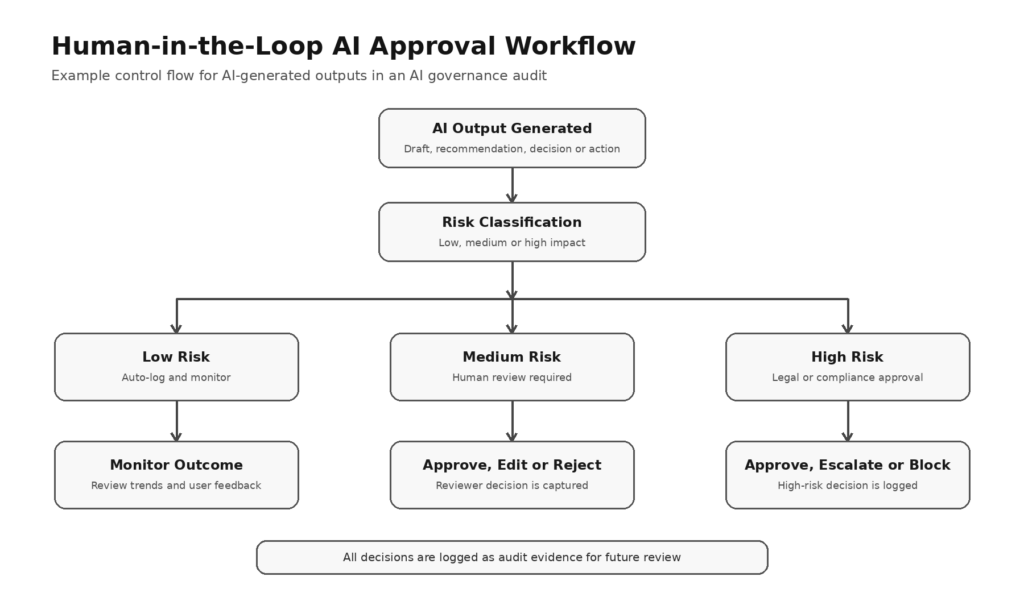
High-impact AI outputs should have review, override, or escalation procedures. AI governance human feedback should be visible in the evidence: reviewers need enough business context, decisions must be logged, overrides should be traceable, and recurring feedback should improve model, prompt, or workflow behavior.
Monitoring and audit trails
An AI governance audit trail should show who used the AI system, what input was provided, what output was generated, which model or prompt version was used, what action was taken, and whether human approval occurred. For regulated or high-impact workflows, the audit trail should also connect approvals, overrides, incidents, and remediation actions to named owners. Without logs, AI governance becomes difficult to prove.
Security and misuse controls
LLM and agentic systems require controls for prompt injection, sensitive information disclosure, insecure output handling, supply chain risk, excessive agency, and unsafe tool use. OWASP’s LLM guidance is useful for structuring this part of the review.
How We Compare
This guide compares AI governance audit components by practical audit value, not by vendor claims. The goal is to help teams decide what to review, what evidence to collect, and which gaps create the most risk.
- Governance relevance: Does the item prove ownership, accountability, policy alignment, or lifecycle control?
- Risk relevance: Does the item reduce legal, security, operational, fairness, privacy, or reputational risk?
- Evidence quality: Can the organization produce documents, logs, approvals, screenshots, test results, or system records?
- Framework alignment: Does the item map to NIST AI RMF, ISO/IEC 42001, EU AI Act readiness, ISO/IEC 23894, SOC 2, or OWASP LLM controls?
- Operational maturity: Is the control repeatable, assigned to an owner, reviewed on a cadence, and updated after changes?
AI Governance Audit Checklist
This AI governance audit checklist can be used as a starting point for internal reviews, vendor assessments, compliance preparation, or consultant-led AI audit services. For each area, collect evidence rather than relying on verbal confirmation.
| Audit area | What to check and collect |
|---|---|
| AI Inventory | Check: whether all AI systems, vendors, internal tools and AI-assisted workflows are documented. Evidence: system register, owner list, vendor list, use-case descriptions and review dates. Risk signal: undocumented AI tools, shadow AI use or no accountable owner. |
| Use Case Classification | Check: whether AI systems are classified by business impact, user impact and regulatory exposure. Evidence: risk matrix, use-case categories and approval records. Risk signal: high-impact workflows treated like low-risk productivity tools. |
| Data Governance | Check: which data sources are used, whether sensitive data is processed and how long inputs and outputs are retained. Evidence: data maps, retention policies, privacy assessments and access permissions. Risk signal: customer data used without clear retention or training controls. |
| Model and Vendor Review | Check: whether internal models and third-party AI vendors have been reviewed before deployment. Evidence: contracts, DPAs, SOC 2 reports, security documentation and vendor questionnaires. Risk signal: AI vendors used without legal, security or procurement review. |
| Prompt and Configuration Control | Check: whether prompts, system instructions, model settings and retrieval sources are versioned. Evidence: prompt history, configuration records and change approvals. Risk signal: teams cannot explain why an AI system behaved differently after a change. |
| Human Oversight | Check: when humans must review, approve, edit, reject or escalate AI outputs. Evidence: approval workflows, reviewer roles, escalation paths and decision logs. Risk signal: high-risk AI outputs are sent to users without review. |
| Monitoring and Incidents | Check: whether outputs, failures, complaints, drift, hallucinations and incidents are tracked. Evidence: logs, monitoring dashboards, incident register and remediation notes. Risk signal: the organization cannot reconstruct what happened after an AI failure. |
What Evidence Should You Collect for an AI Governance Audit?
The strongest AI governance audits are evidence-driven. Policies and frameworks matter, but an audit becomes credible only when the organization can show records that prove ownership, risk classification, data controls, vendor review, human oversight, monitoring, and remediation. Strong AI governance documentation connects policy to proof: system registers, data approvals, vendor reviews, monitoring logs, incidents, and remediation owners. This is what makes AI governance and compliance auditable for enterprise procurement, customer security reviews, and board-level AI risk reporting.
A practical rule is simple: every high-impact AI system should have an owner, a documented use case, approved data sources, vendor evidence, monitoring records, approval rules, and a clear remediation path for findings.
| Evidence area | What to collect |
|---|---|
| AI Inventory | Collect: AI system register, business owners, use cases, vendors, models, customer-facing status, risk level and last review date. Why it matters: auditors need to confirm that the organization knows which AI systems exist and who is accountable for each one. |
| Data Governance | Collect: data sources, access permissions, retention rules, DPIAs where applicable, sensitive data handling notes and training-data restrictions. Why it matters: AI risks often begin with unclear data usage, excessive access or undocumented retention. |
| Vendor Management | Collect: vendor contracts, DPAs, SOC 2 reports, ISO certificates, data processing terms, subprocessor lists and security questionnaires. Why it matters: third-party AI vendors can introduce privacy, security, operational and compliance risks. |
| Human Oversight | Collect: approval workflows, escalation paths, reviewer roles, legal review rules and decision logs for medium- and high-risk outputs. Why it matters: an audit should prove when AI can act automatically and when a human must approve, edit or block an output. |
| Monitoring and Incidents | Collect: output logs, evaluation results, user feedback, incident records, root-cause analysis and remediation history. Why it matters: organizations need evidence that AI systems are monitored after launch, not only approved before launch. |
| Security Controls | Collect: access logs, role permissions, prompt injection tests, red-team results, OWASP LLM checks and remediation records. Why it matters: LLM applications and AI agents can create risks such as sensitive information disclosure, insecure tool use and excessive agency. |
| Policies and Training | Collect: acceptable AI use policy, AI risk policy, employee AI guidelines, training records, disclosure rules and policy exceptions. Why it matters: governance only works when employees know what is allowed, what requires review and how to report issues. |
AI Governance Audit Frameworks for 2026
A strong AI governance audit does not need to reinvent the control model. It should connect AI governance risk and compliance requirements to recognized frameworks, standards, and evidence artifacts. The right combination depends on jurisdiction, industry, maturity, and risk exposure.
NIST AI Risk Management Framework
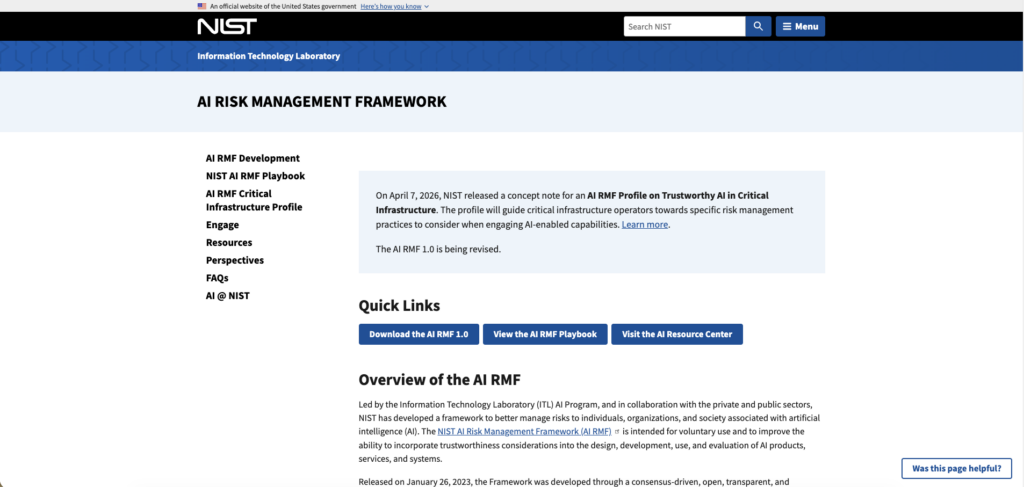
The NIST AI RMF is useful for structuring risk management around the functions Govern, Map, Measure, and Manage. It is especially helpful for organizations that need a practical risk language across legal, security, product, and executive teams.
ISO/IEC 42001
ISO/IEC 42001 is designed for AI management systems. It is particularly relevant when an organization wants a formal, repeatable operating model for AI governance, not just an ad hoc policy. Teams exploring AI governance certification should treat certification readiness as an evidence-quality goal, not as a substitute for risk assessment, technical testing, or remediation.
EU AI Act readiness
The EU AI Act uses a risk-based structure and creates obligations for certain AI systems, especially high-risk systems. Even companies outside the EU should understand whether their AI products, customers, or data flows create EU exposure.

ISO/IEC 23894
ISO/IEC 23894 focuses on AI risk management. It can support risk identification, analysis, evaluation, treatment, monitoring, and communication across the AI lifecycle.
SOC 2 control overlap
SOC 2 is not an AI governance standard, but many AI controls overlap with security, availability, confidentiality, processing integrity, privacy, change management, access control, logging, vendor management, and incident response.
OWASP Top 10 for LLM Applications
For LLM-based products and AI agents, OWASP helps security teams test risks such as prompt injection, sensitive information disclosure, supply chain vulnerabilities, improper output handling, excessive agency, and model denial of service.
AI Governance Audit Process: Step by Step
A serious AI governance audit should follow a repeatable process. The exact depth depends on whether the review is internal, consultant-led, regulatory, or tied to enterprise procurement.
1. Define audit scope
Decide whether the audit covers the entire organization, one business unit, one AI product, one vendor, one LLM workflow, or one regulated use case. Scope clarity prevents weak findings and prevents AI audit cost from expanding without control.
2. Build the AI inventory
Collect every known AI use case, including customer-facing AI, employee copilots, embedded SaaS features, analytics models, code tools, support automation, marketing tools, agentic workflows, and shadow AI.
3. Classify risk
Rate each system by business criticality, data sensitivity, autonomy, user impact, regulatory exposure, and potential harm. High-risk systems need deeper evidence and more frequent review.
4. Map frameworks and obligations
Map each system to relevant internal policies, customer commitments, laws, and frameworks. For example, a SaaS support chatbot may need privacy and security controls, while a loan underwriting model requires stronger governance risk controls and fairness review.
5. Review documentation and evidence
Collect policies, system diagrams, data flows, vendor documents, model cards, prompt records, logs, test results, security reviews, and incident records. Evidence should be current, traceable, and owned.
6. Test selected controls
Do not only read policies. Test whether access control, logging, human approval, escalation, output monitoring, and change management actually work.
7. Rate findings
Classify gaps by severity, likelihood, business impact, compliance exposure, and remediation complexity. High-severity findings should have clear owners and deadlines.
8. Create the remediation plan
The audit is only useful if it changes behavior. Assign each finding to a responsible owner, set due dates, define acceptance criteria, and schedule re-testing.
Recommended approach for SaaS teams
Start with a focused AI governance audit for customer-facing AI features and internal AI tools that process customer data. Then expand to AI agents, sales and marketing automation, HR workflows, finance workflows, and third-party AI vendors.
AI Governance Audit Report Example
An AI governance audit report should be understandable to executives and useful to operators. It should not be a long policy essay. It should show what was reviewed, what evidence was found, what gaps matter, and what must happen next.
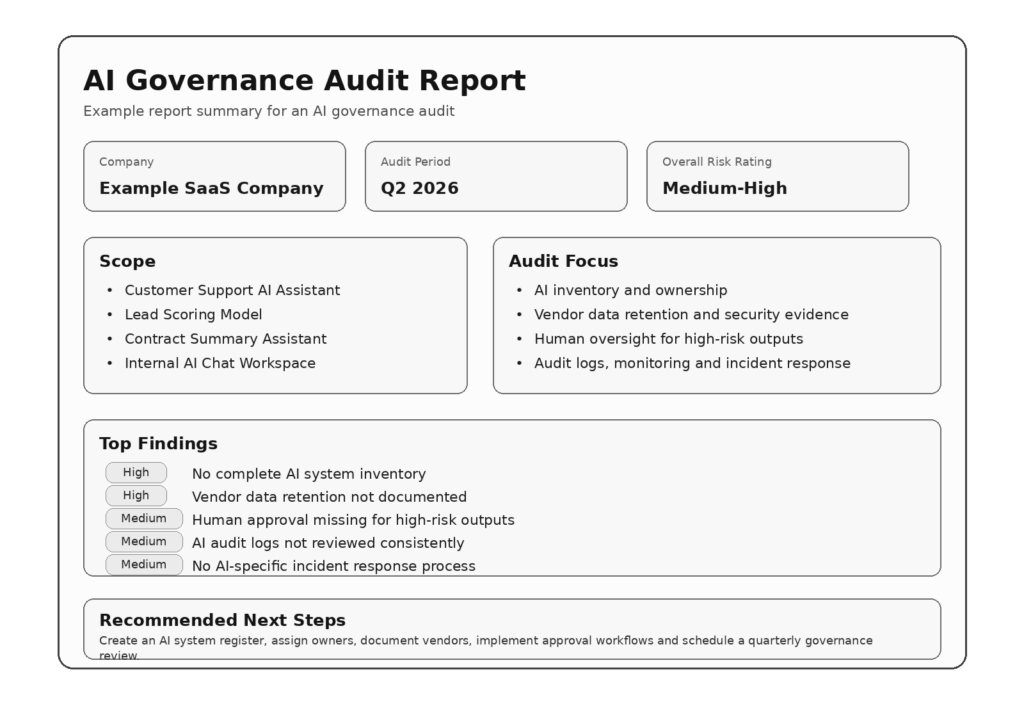
Recommended report structure
- Executive summary: Overall maturity, top risks, and business impact.
- Audit scope: Systems, teams, vendors, workflows, and dates reviewed.
- Framework mapping: NIST AI RMF, ISO/IEC 42001, EU AI Act readiness, SOC 2 overlap, OWASP LLM controls, or internal policy mapping.
- Evidence reviewed: Documents, logs, screenshots, interviews, test results, contracts, and system records.
- Findings: Risk-rated gaps with severity, likelihood, evidence, impact, and recommendation.
- Remediation plan: Owners, deadlines, priority, acceptance criteria, and follow-up cadence.
- Residual risk: Risks that remain after remediation or require executive acceptance.
| Finding | Why it matters and how to fix it |
|---|---|
| No complete AI inventory | Why it matters: the company cannot govern systems it cannot see. Evidence: missing or incomplete AI system register. Recommended fix: create an owner-based AI inventory and require quarterly updates. |
| No prompt version control | Why it matters: teams cannot explain changes in output behavior. Evidence: prompts are edited directly in tools without review history. Recommended fix: version prompts, system instructions and retrieval sources. |
| Missing vendor AI review | Why it matters: customer data, retention and security obligations may be unclear. Evidence: no DPA, no data retention terms or no vendor security review. Recommended fix: route AI vendors through procurement, legal and security review. |
| Insufficient audit logs | Why it matters: incidents cannot be reconstructed or defended during customer reviews. Evidence: no reliable logs for prompts, outputs, approvals or model changes. Recommended fix: log high-impact AI decisions and review logs periodically. |
Common AI Governance Audit Findings
Many organizations discover similar weaknesses during AI governance audits. These gaps can appear in startups, SaaS companies, financial institutions, government vendors, and enterprises.
- No complete AI inventory.
- No assigned system owner for each AI use case.
- No AI-specific vendor due diligence.
- No documented data sources or retention settings.
- No risk classification for AI systems.
- No human review for high-impact outputs.
- No prompt or model version control.
- No AI incident response procedure.
- No output monitoring after deployment.
- No fairness or bias review for sensitive use cases.
- No audit trail for AI-generated decisions or actions.
- No approval limits for AI agents using external tools.
- No clear policy for employee use of public AI tools.
- No formal remediation plan after audit findings.
For public sector and regulated organizations, these gaps may be framed as control deficiencies, security weaknesses, governance deficiencies, or material weaknesses depending on the audit context.
AI Governance Audit Tools
AI audit tools can help, but they do not replace governance design. The best AI governance tools for compliance workflows help teams maintain system inventories, assign owners, map controls to frameworks, collect evidence, monitor changes, and prepare audit-ready reports. They cannot decide the organization’s risk appetite, legal obligations, or accountability model.
Tool categories to evaluate
| Tool category | Best use and audit evidence |
|---|---|
| AI Governance Platforms | Helps with: AI inventory, policy management, risk classification and control workflows. Evidence produced: system registers, ownership records, review status and governance dashboards. |
| GRC Platforms | Helps with: control mapping, evidence collection, issue tracking and audit workflows. These are often the core compliance tools for AI governance and auditing when teams need repeatable controls rather than one-off spreadsheets. Evidence produced: control records, remediation tickets, audit trails and compliance mappings. |
| LLM Evaluation Tools | Helps with: quality checks, benchmark testing, hallucination evaluation and regression testing. Evidence produced: evaluation results, test datasets, model comparison records and failure examples. |
| LLM Observability Tools | Helps with: monitoring prompts, outputs, latency, cost, user feedback and production traces. Evidence produced: trace logs, model version data, error records and operational metrics. |
| AI Security Testing Tools | Helps with: prompt injection testing, data leakage checks, red teaming and abuse scenarios. Evidence produced: security findings, test results, exploit examples and remediation records. |
| Data Governance Tools | Helps with: data lineage, classification, access control and retention management. Evidence produced: data maps, permissions, lineage records and retention settings. |
| Vendor Risk Tools | Helps with: AI vendor intake, security questionnaires, contract reviews and renewal monitoring. Evidence produced: DPAs, SOC 2 reports, vendor questionnaires and approval history. |
Searches such as AI governance and auditing compliance tools providers companies usually indicate a commercial evaluation stage. For that intent, include a checklist of tool requirements rather than only a list of vendors.
AI Governance Audit Cost
AI audit cost varies widely because the scope varies widely. A lightweight internal AI audit checklist for a small SaaS team may take days. A regulated enterprise review across dozens of AI systems, vendors, data flows, model tests, and legal obligations can take months.
| Audit scenario | Typical scope and cost drivers |
|---|---|
| Internal Readiness Review | Typical scope: one team or a small group of AI systems, basic inventory and gap analysis. Cost drivers: staff time, documentation maturity, number of vendors and whether legal review is needed. Best for: startups and SaaS teams preparing their first AI governance process. |
| Consultant-Led Governance Audit | Typical scope: organization-wide inventory, framework mapping, interviews, evidence review and remediation roadmap. Cost drivers: number of AI systems, business units, data sensitivity, stakeholder interviews and report depth. Best for: growing companies preparing for enterprise customers or board-level risk review. |
| Regulated AI Audit | Typical scope: high-impact systems, compliance mapping, fairness checks, privacy review and legal evidence. Cost drivers: regulated industry exposure, documentation gaps, model complexity and required testing depth. Best for: finance, healthcare, HR, insurance and other high-impact use cases. |
| Continuous AI Governance Program | Typical scope: recurring audits, monitoring, policy updates, incident reviews and ongoing control testing. Cost drivers: tooling, governance ownership, risk review cadence and the number of active AI workflows. Best for: enterprises and AI-native SaaS companies with multiple production AI systems. |
What drives AI audit cost?
The biggest cost drivers are the number of AI systems, number of vendors, sensitivity of data, industry risk, documentation maturity, need for technical testing, number of interviews, depth of framework mapping, legal review, and whether remediation support is included.
AI Governance Audit for AI Agents
AI agents make governance more complex because they do not only generate content. They can plan tasks, call tools, access systems, update records, send messages, trigger workflows, retrieve private data, or execute transactions. That means agentic AI governance must audit both outputs and actions.
Agent-specific audit questions
- Which tools, APIs, databases, and external systems can the agent access?
- What actions can the agent execute without human approval?
- Are there transaction limits, rate limits, spending limits, or approval gates?
- Can the organization reconstruct the agent’s reasoning path, tool calls, and outputs?
- Is agent memory controlled, retained, and deletable?
- Are tool permissions separated by role, tenant, customer, and environment?
- Can unsafe actions be rolled back?
- Are MCP servers, plugins, connectors, and workflow automations reviewed as part of the AI system?
For AI agents, excessive agency is not just a security concept. It is a governance concern. The audit should prove that autonomy is bounded, logged, approved, monitored, and aligned with business risk.
AI Governance Audit for SaaS Companies
For SaaS companies, an AI governance audit should be designed around customer trust and enterprise readiness. Buyers increasingly ask how AI features use customer data, whether data trains third-party models, how outputs are reviewed, whether logs are available, and whether AI can be disabled or configured by administrators.
SaaS-specific audit areas
- Customer-facing AI feature inventory.
- Internal employee AI tool inventory.
- Customer data usage and training restrictions.
- Tenant isolation and access control.
- AI output disclaimers and user-facing transparency.
- Admin controls for enabling, disabling, or limiting AI features.
- Model provider dependency and fallback strategy.
- Enterprise audit logs and customer evidence exports.
- SOC 2 control overlap for change management, access, incident response, vendor management, and logging.
AI Fairness, Bias, and Inclusivity in Governance Audits
Not every AI governance audit needs a full fairness study. However, fairness becomes important when AI affects people’s access to jobs, housing, credit, education, healthcare, insurance, public benefits, or other consequential opportunities.
Queries such as why is auditing AI models for fairness and inclusivity important, AI fairness audit, AI fairness auditing, cost of professional AI fairness audit, companies specializing in AI bias detection auditing fairness testing, and fair housing compliance auditing AI leasing conversations reflect a narrow but high-stakes search intent.
What to review for fairness
A fairness review should assess whether the data is representative, whether protected or sensitive attributes are used directly or indirectly, whether outcomes differ across groups, whether the model has been tested for disparate impact, and whether there is a remediation process for harmful patterns.
How to Prepare for an AI Governance Audit
Preparation reduces AI audit cost and improves the quality of findings. Before an audit begins, create a central evidence folder and assign a responsible owner for each system.
| Problem | Solution Approach |
|---|---|
| AI tools are used across teams without central visibility. | Create an AI inventory and require teams to register AI systems, vendors, use cases, data categories, and owners. |
| No one owns AI governance evidence. | Assign an AI governance lead and system owners for product, engineering, legal, compliance, security, and data governance evidence. |
| Vendor terms are unclear. | Collect DPAs, security reports, data retention terms, sub-processor lists, and training-use restrictions for every AI vendor. |
| Prompts and model settings are not documented. | Move prompts, system instructions, retrieval configuration, and model settings into version-controlled documentation. |
| Logs cannot reconstruct AI behavior. | Capture input, output, user, model version, prompt version, tool calls, approvals, timestamps, and final actions. |
Templates for an AI Governance Audit
An AI governance framework template should not be a static policy PDF. It should connect the AI governance checklist, system inventory, risk register, vendor review, evidence log, and audit report into one repeatable operating model. The best templates help teams collect evidence, assign owners, and update risk over time.
- AI system inventory template: Tracks use case, owner, data, vendor, model, users, risk level, and review cadence.
- AI risk register: Tracks risk description, likelihood, impact, controls, residual risk, owner, and due date.
- AI vendor review questionnaire: Captures model provider, training use, retention, sub-processors, security reports, privacy terms, and breach notification process.
- AI incident log: Records harmful outputs, privacy issues, bias complaints, system failures, root cause, response, and remediation.
- AI audit evidence checklist: Lists documents, screenshots, logs, interviews, test results, approvals, and framework mappings.
- AI governance audit report template: Standardizes executive summary, scope, findings, recommendations, owners, and residual risk.
FAQ
What is an AI governance audit?
An AI governance audit is a structured review of how an organization manages AI systems, risks, controls, documentation, monitoring, and accountability. It checks whether AI systems are inventoried, classified, supervised, logged, and aligned with policies, standards, and applicable laws. For responsible AI governance, the audit should prove that ownership, risk controls, evidence, and escalation paths work in daily operations.
How is an AI governance audit different from an AI audit?
An AI audit can refer to many types of review, including performance, fairness, security, or compliance testing. An AI governance audit focuses specifically on the operating model around AI: policies, ownership, risk controls, evidence, human oversight, vendor management, and lifecycle governance.
What is an AI governance audit trail?
An AI governance audit trail is the evidence record that shows how an AI system was used, monitored, approved, changed, and remediated over time. It should connect prompts, outputs, model versions, data sources, human approvals, incidents, and control changes to accountable owners.
What should be included in an AI audit checklist?
An AI audit checklist should include AI inventory, risk classification, data governance, vendor review, model documentation, prompt control, human oversight, security controls, monitoring, audit logs, incident response, policy training, and remediation tracking.
How often should a company run an AI governance audit?
High-risk or customer-facing AI systems should be reviewed at least quarterly or after major model, vendor, data, or workflow changes. Lower-risk internal AI tools may be reviewed annually, but the AI inventory should remain current throughout the year.
How much does an AI governance audit cost?
AI governance audit cost depends on scope, risk, system count, industry, evidence maturity, and testing depth. A small internal readiness review may cost mainly staff time, while a consultant-led or regulated audit can range from tens of thousands to hundreds of thousands of dollars.
Which frameworks are useful for an AI governance audit?
Useful frameworks include the NIST AI Risk Management Framework, ISO/IEC 42001, ISO/IEC 23894, EU AI Act readiness, SOC 2 control overlap, and OWASP Top 10 for LLM Applications. The right mix depends on business model, jurisdiction, industry, and risk level.
Does an AI governance audit cover ChatGPT and employee AI use?
Yes, it should. Internal AI tools, employee copilots, public AI platforms, customer-facing AI features, and embedded third-party AI systems should all be included if they process business data or influence business decisions.
Is an AI governance audit required by law?
Not every organization is legally required to run a formal AI governance audit. However, regulated industries, high-risk AI systems, enterprise contracts, privacy obligations, and the EU AI Act may create practical or legal pressure to document AI governance controls.
What are common AI governance audit findings?
Common findings include missing AI inventory, unclear system ownership, weak vendor review, undocumented data sources, no prompt version control, insufficient logs, missing human oversight, no incident process, and no remediation tracking.
Who should own AI governance auditing?
AI governance auditing should be cross-functional. A typical ownership model includes legal, compliance, security, privacy, product, engineering, data governance, and an executive sponsor. Each AI system should also have a named business owner.
Sources and Further Reading
- NIST AI Risk Management Framework
- NIST AI Risk Management Framework 1.0 PDF
- ISO/IEC 42001 Artificial Intelligence Management System
- ISO/IEC 23894 Artificial Intelligence Risk Management
- European Commission: AI Act Regulatory Framework
- European Commission: Draft Guidelines on Classification of High-Risk AI Systems
- OWASP Top 10 for Large Language Model Applications
- OWASP Top 10 for Large Language Model Applications 2023 v1.1 PDF
- Google Search Central: AI Features and Your Website
- Google Search Central: A New Resource for Optimizing for Generative AI in Google Search
- Google Search Central: Creating Helpful, Reliable, People-First Content