Use this AI search optimization checklist to audit whether your website can be found, understood, trusted, and cited by ChatGPT, Perplexity, and Google AI Overviews. It is designed for business, SEO, and content teams that want a practical readiness check, not a generic guide to AI search.
AI Summary
Quick Answer
A website is ready for AI search when important pages are crawlable, technically indexable, answer-first, source-backed, entity-clear, and tested against real ChatGPT, Perplexity, and Google AI Overview prompts.
- First check access: AI systems cannot cite pages blocked by robots.txt, WAF rules, login walls, restrictive meta tags, or broken canonicals.
- Then check extraction: Each strategic page needs direct answers, concise definitions, clear tables, FAQ answers, and visible source references.
- Separate crawler policies: Search crawlers, training crawlers, and user-triggered fetchers have different roles and should not be handled with one blanket rule.
- Measure prompts: Track citations and mentions across real buyer, research, and implementation prompts instead of relying only on classic rankings.
How to Use This Checklist
Start with your five most valuable public pages: a homepage, category hub, comparison article, pricing or service page, and one high-intent guide. Mark each checklist item as complete, needs work, or not relevant. Fix access and technical blockers before rewriting content.
| Status | Meaning |
|---|---|
| Complete | The page is crawlable, visible, source-backed, and already tested against real AI-search prompts. |
| Needs work | The page is partly optimized but has a blocking issue, weak answer structure, missing sources, or unclear entity signals. |
| Not relevant | The item does not apply to this page type, such as schema for an interactive tool when the page is only an article. |
AI Search Readiness Scorecard
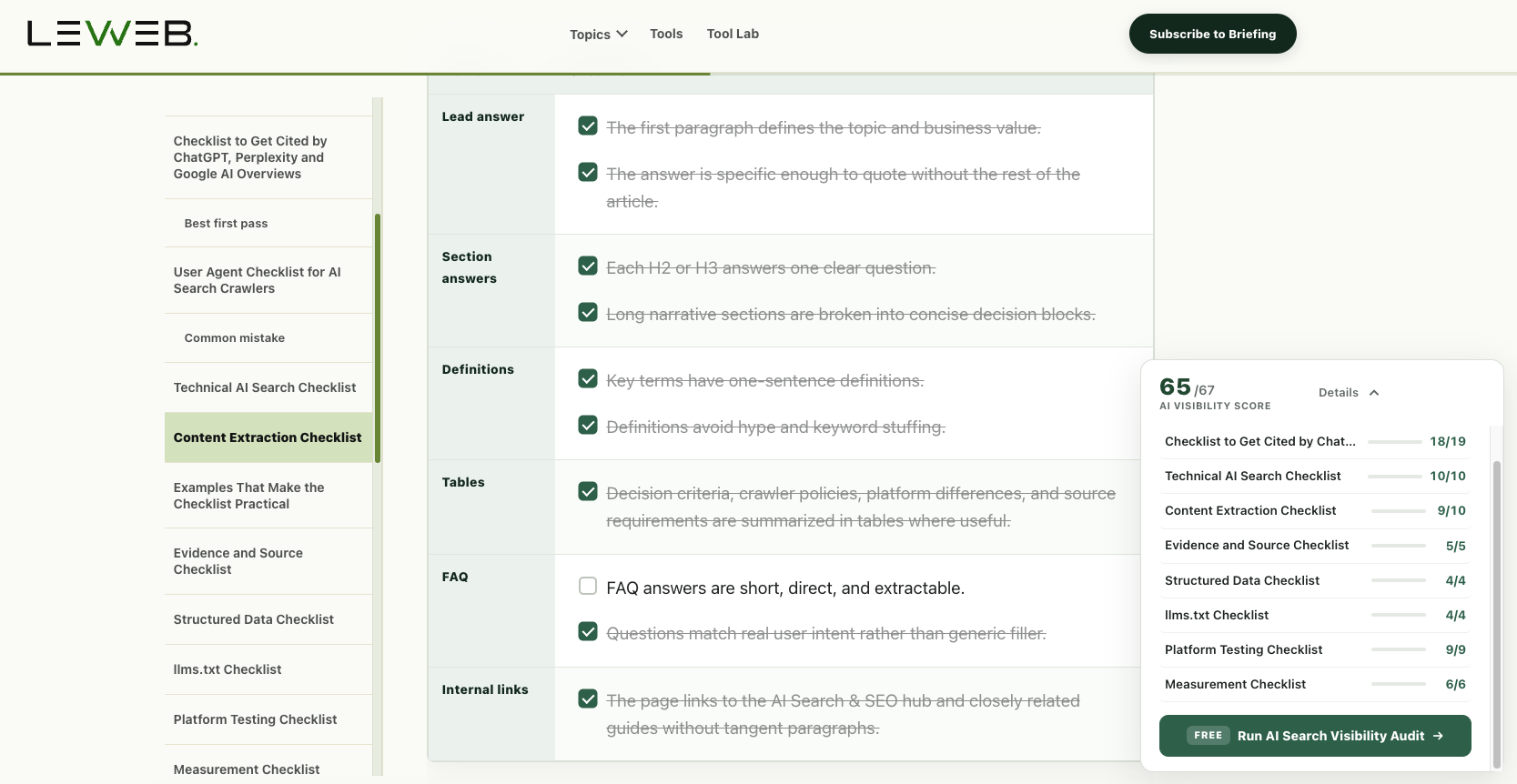
Each checklist item is weighted by impact: critical blockers are worth 4 points, important checks 2 points, moderate checks 1 point, and optional checks 0.5 points. The interactive score bar at the bottom of this page tracks your progress automatically toward a maximum of 100 points. When you are done, run the free AI Search Visibility Audit to check your pages automatically. Use the score to decide whether a page is ready for AI citations or still needs technical, content, or trust work.
| Result | Interpretation |
|---|---|
| Not ready | Score: 0–30 points. Meaning: The page has access, indexing, structure, or evidence gaps that can prevent AI systems from finding or trusting it. |
| Needs work | Score: 31–60 points. Meaning: The page is partly visible but still weak for citation because key answers, sources, entity signals, or platform checks are missing. |
| Citation-ready | Score: 61–80 points. Meaning: The page has a strong foundation but should still be improved with better examples, sources, prompt testing, or conversion paths. |
| Strong | Score: 81–100 points. Meaning: The page is technically accessible, extractable, source-backed, and ready for recurring AI-search measurement. |
Use it as an audit intake
For a practical AI Search Visibility Audit, score your top five commercial pages first. You can also run the free automated audit tool on any URL to check crawlability, structured data, and answer extraction automatically. Prioritize pages that already have backlinks, rankings, product intent, pricing intent, or comparison intent.
Copyable AI Search Audit Worksheet
Copy this worksheet into a spreadsheet or Notion database before auditing pages. One row should represent one URL.
| Field | What to record |
|---|---|
| URL | The page being audited, such as homepage, category hub, comparison guide, pricing page, template page, or high-intent article. |
| Page goal | The business outcome the page should support: AI citation, audit request, newsletter signup, tool usage, demo, affiliate click, or vendor evaluation. |
| Score | The number of completed checklist items from this article. |
| Blocked items | The most important failed items, especially crawler access, noindex, snippet restrictions, weak sources, missing FAQ, or no prompt testing. |
| Priority fix | The one fix that should happen first. Choose the blocker that would most improve crawlability, extractability, trust, or conversion. |
| Retest date | The date when ChatGPT, Perplexity, and Google AI Overviews prompts should be tested again. |
Checklist to Get Cited by ChatGPT, Perplexity and Google AI Overviews
This is the quick version. If a page fails several items here, it is not ready for AI citations yet.
| Area | Checklist |
|---|---|
| Crawl access | ☐ Important pages return a clean 200 status for non-logged-in visitors.☐ Robots.txt does not block search crawlers needed for AI visibility. ☐ WAF, CDN, bot protection, and rate limits do not block legitimate AI search crawlers. |
| Indexing | ☐ Strategic pages are not set to noindex.☐ Meta robots and X-Robots-Tag do not unnecessarily restrict snippets or previews. ☐ Canonicals point to the correct primary URL. |
| Page structure | ☐ The page opens with a direct answer. ☐ Each major section answers one clear question. ☐ The page includes tables, definitions, and FAQ answers where they help extraction. |
| Evidence | ☐ Technical claims link to official documentation. ☐ Pricing, feature, compliance, or benchmark claims cite primary sources. ☐ The page has a clear sources section. |
| Entity clarity | ☐ The company, product, author, category, and expertise are easy to identify. ☐ Internal links connect the page to the relevant hub and related resources. ☐ External profiles or mentions support the entity where possible. |
| AI testing | ☐ Target prompts are tested in ChatGPT, Perplexity, and Google AI Overviews. ☐ Competitor citations are recorded. ☐ Missing citations lead to specific page improvements. |
| Conversion path | ☐ The page leads naturally to a checklist download, audit, template, tool, newsletter, demo, or vendor evaluation step. |
Best first pass
If you only have one hour, check crawler access, indexing controls, the first answer block, and source quality on your most valuable page. These are the fastest ways to find blockers.
User Agent Checklist for AI Search Crawlers
Use this table as the practical robots.txt and WAF reference. The key point is separation: search crawlers, training crawlers, and user-triggered fetchers do not have the same business purpose.
| Name | User agent |
|---|---|
| OAI-SearchBot | Full string: Mozilla/5.0 (Macintosh; Intel Mac OS X 10_15_7) AppleWebKit/537.36 (KHTML, like Gecko) Chrome/131.0.0.0 Safari/537.36; compatible; OAI-SearchBot/1.3; +https://openai.com/searchbotUse: OpenAI search crawler for surfacing websites in ChatGPT search features. Checklist: Allow it on public pages you want eligible for ChatGPT search citations. |
| GPTBot | Full string: Mozilla/5.0 AppleWebKit/537.36 (KHTML, like Gecko); compatible; GPTBot/1.3; +https://openai.com/gptbotUse: OpenAI crawler related to training controls. Checklist: Treat it separately from ChatGPT search visibility. |
| ChatGPT-User | Full string: Mozilla/5.0 AppleWebKit/537.36 (KHTML, like Gecko); compatible; ChatGPT-User/1.0; +https://openai.com/botUse: User-triggered visits from ChatGPT or Custom GPTs. Checklist: OpenAI says it is not used to determine whether content may appear in Search. |
| PerplexityBot | Full string: Mozilla/5.0 AppleWebKit/537.36 (KHTML, like Gecko; compatible; PerplexityBot/1.0; +https://perplexity.ai/perplexitybot)Use: Perplexity crawler for surfacing and linking websites in Perplexity search results. Checklist: Allow it on pages you want Perplexity to discover and cite. |
| Perplexity-User | Full string: Mozilla/5.0 AppleWebKit/537.36 (KHTML, like Gecko; compatible; Perplexity-User/1.0; +https://perplexity.ai/perplexity-user)Use: User-triggered Perplexity fetcher. Checklist: Perplexity says it is not used for web crawling or training and generally ignores robots.txt because the fetch is user initiated. |
| Googlebot | Robots token: GooglebotUse: Google Search crawling and indexing, including systems that support Google Search features. Checklist: Follow Google’s standard crawling, indexing, and quality guidance first. |
| Google-Extended | Robots token: Google-ExtendedUse: Google product token for certain Gemini and Vertex AI uses. Checklist: Google states it does not affect inclusion or ranking in Google Search, so do not confuse it with Googlebot access for Search or AI Overviews. |
Common mistake
Do not block or allow every AI-related user agent with one rule. A company may want to restrict training use while still allowing search visibility in ChatGPT or Perplexity.
Technical AI Search Checklist
Technical SEO is still the base layer. Google states that SEO best practices remain relevant for its generative AI features because those features are rooted in Google Search ranking and quality systems.
| Check | Pass condition |
|---|---|
| Robots.txt | ☐ Public money pages, category hubs, and high-intent articles are not accidentally blocked. ☐ Search crawlers and training crawlers are handled according to separate business goals. |
| Status codes | ☐ Important URLs return 200.☐ Redirects are intentional, short, and point to the canonical page. |
| Canonicals | ☐ Strategic pages use self-referencing canonicals. ☐ No high-intent article canonicalizes to a thin duplicate or unrelated hub. |
| Snippets | ☐ Meta robots and X-Robots-Tag do not use unnecessary nosnippet, restrictive previews, or hidden header rules on pages meant for AI visibility. |
| Rendering | ☐ The main answer, comparison table, FAQ, and source links are visible in crawlable HTML, not only after JavaScript interaction. |
| Sitemaps | ☐ XML sitemaps include strategic pages with accurate update signals. ☐ Internal links also point to those pages from relevant hubs. |
Content Extraction Checklist
AI systems need passages that can be extracted without losing meaning. Every strategic page should make the answer obvious, supported, and easy to quote.
| Element | Checklist |
|---|---|
| Lead answer | ☐ The first paragraph defines the topic and business value. ☐ The answer is specific enough to quote without the rest of the article. |
| Section answers | ☐ Each H2 or H3 answers one clear question. ☐ Long narrative sections are broken into concise decision blocks. |
| Definitions | ☐ Key terms have one-sentence definitions. ☐ Definitions avoid hype and keyword stuffing. |
| Tables | ☐ Decision criteria, crawler policies, platform differences, and source requirements are summarized in tables where useful. |
| FAQ | ☐ FAQ answers are short, direct, and extractable. ☐ Questions match real user intent rather than generic filler. |
| Internal links | ☐ The page links to the AI Search & SEO hub and closely related guides without tangent paragraphs. |
Examples That Make the Checklist Practical
Use these examples to avoid turning the checklist into vague SEO advice. The goal is to make each page easier to crawl, quote, verify, and cite.
| Example | Better implementation |
|---|---|
| Answer block | Weak: “In today’s changing digital landscape, AI search is becoming important.” Better: “AI search optimization makes pages crawlable, extractable, source-backed, and citation-ready for AI answer engines.” |
| Robots policy | Weak: Block every AI-related bot with one Disallow: / rule.Better: Decide separately for search visibility, training control, and user-triggered fetches. For example, OAI-SearchBot and GPTBot do not serve the same purpose. |
| Source quality | Weak: “AI engines prefer structured data” with no source or explanation. Better: Cite Google Search Central or Schema.org and explain that structured data helps clarify visible page meaning; it does not guarantee citation. |
| Prompt testing | Weak: Ask one random prompt once and treat the result as proof. Better: Test a fixed prompt set monthly across ChatGPT, Perplexity, and Google AI Overviews, then record citations, competitors, answer accuracy, and the cited URL. |
Evidence and Source Checklist
AI search visibility depends on trust. Replace vague claims with verifiable references and use primary sources for technical or business-critical statements.
| Claim type | Required source |
|---|---|
| Crawler behavior | ☐ Cite official documentation from OpenAI, Perplexity, Google, Bing, or the relevant platform. |
| Search features | ☐ Cite Google Search Central or official platform documentation for AI Overviews, AI Mode, crawling, indexing, and snippet controls. |
| Structured data | ☐ Cite Google Search Central and Schema.org when explaining schema, rich results, or entity markup. |
| Tools | ☐ Cite official vendor pages for pricing, features, limits, integrations, and product claims. |
| Compliance | ☐ Cite official regulators, standards bodies, or qualified guidance; avoid presenting legal advice as definitive. |
Structured Data Checklist
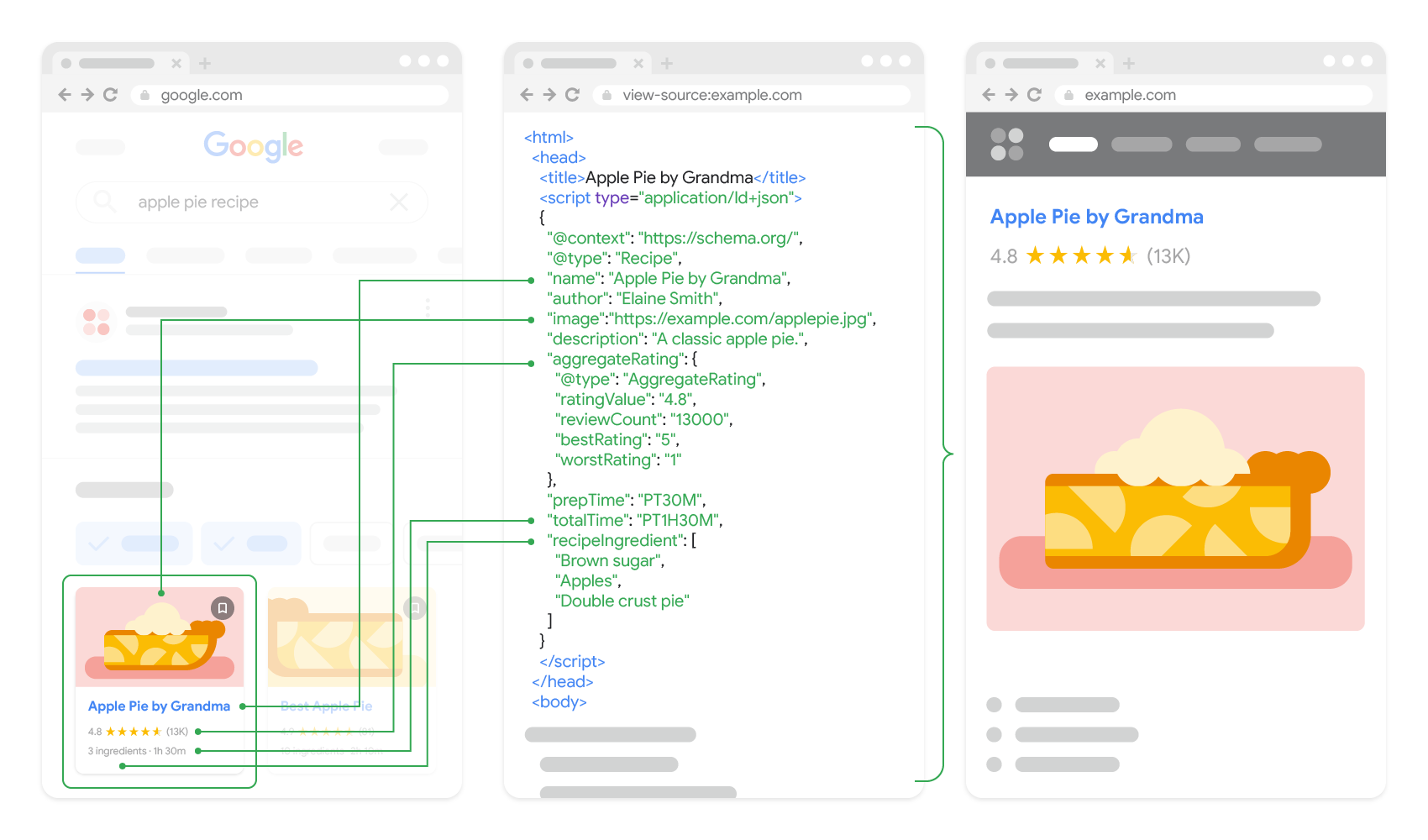
Structured data is not a shortcut to AI citations. It helps search systems understand page meaning when the markup accurately reflects visible content.
| Page type | Checklist |
|---|---|
| Article | ☐ Use Article schema with author, publisher, headline, datePublished, dateModified, and canonical URL where appropriate. |
| FAQ | ☐ Keep visible FAQs when they help users. FAQPage may remain as general Schema.org markup, but do not treat FAQ markup as a current Google rich-result growth lever. |
| Tool | ☐ Use SoftwareApplication or WebApplication only when the page contains a real tool, calculator, generator, or app. |
| Comparison | ☐ Use ItemList, Product, or SoftwareApplication only when the compared entities and properties are accurate and visible. |
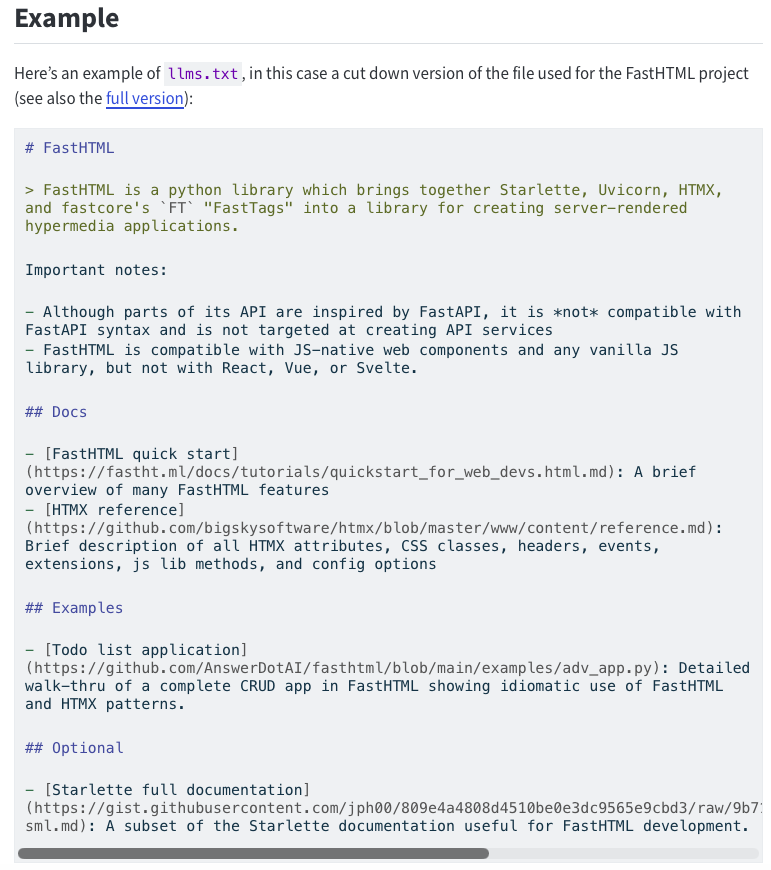
llms.txt Checklist
An /llms.txt file can provide LLM-friendly context and curated links, especially for documentation-heavy websites, developer tools, APIs, templates, research hubs, and AI products. It should not replace crawlability, internal linking, schema, or strong content.
| Check | Pass condition |
|---|---|
| Use case | ☐ The site has documentation, tools, APIs, templates, research, or structured resources worth curating for LLMs. |
| Scope | ☐ The file lists the most important resources, not every URL on the site. |
| Format | ☐ The file uses clean Markdown and clear section labels. |
| Expectation | ☐ The team understands that Google says llms.txt is not required to appear in Google Search or its generative AI capabilities. |
Platform Testing Checklist
Do not assume ChatGPT, Perplexity, and Google AI Overviews cite the same pages. Test the same prompt set across each platform and record the differences.
| Platform | Checklist |
|---|---|
| ChatGPT | ☐ Test buying, comparison, alternatives, and implementation prompts. ☐ Record whether your brand appears, whether the correct page is cited, and which competitors appear. ☐ Review OAI-SearchBot access if your pages never appear. |
| Perplexity | ☐ Test research-heavy prompts where users expect cited sources. ☐ Check whether Perplexity cites your original page or a competitor summary. ☐ Review PerplexityBot access and WAF allowlisting if needed. |
| Google AI | ☐ Test queries that trigger AI Overviews or AI Mode responses. ☐ Check classic ranking, citation appearance, snippet controls, and structured data validity. ☐ Follow Google Search fundamentals before chasing platform-specific tactics. |
Measurement Checklist
Classic rankings are not enough. AI search optimization should track citations, unlinked mentions, answer accuracy, crawler access, and conversion paths.
| Metric | Checklist |
|---|---|
| Prompt set | ☐ Maintain a fixed list of buyer, research, comparison, and implementation prompts. ☐ Retest monthly and after major page changes. |
| Citations | ☐ Track whether your page is cited, which URL is cited, and whether the answer represents your claim accurately. |
| Competitors | ☐ Record which competitors appear repeatedly and what their cited pages do better. |
| Logs | ☐ Review server logs for crawler access, blocked requests, repeated errors, and pages with no crawler activity. |
| Outcomes | ☐ Connect AI-visible pages to newsletter signups, audit requests, tool usage, demos, or affiliate clicks. |
Best Next Step
Use this checklist to prepare for an AI Search Visibility Audit. Start with the pages that already influence revenue or demand: homepage, category hubs, comparison pages, pricing pages, tools, templates, and high-intent articles.
Recommended audit order
Fix access and indexing first, rewrite the top answer block second, upgrade sources third, then retest prompts in ChatGPT, Perplexity, and Google AI Overviews.
Run Your Free AI Search Visibility Audit
Completed the checklist? Now run a full automated AI Search Visibility Audit on your website. The audit checks crawlability, structured data, answer extraction, source quality, and entity clarity — the same areas covered in this checklist, but evaluated automatically for any URL.
FAQ
What is an AI search optimization checklist?
An AI search optimization checklist is a practical audit list for checking whether a website is crawlable, understandable, trustworthy, and citation-ready for AI answer engines.
How do I get cited by ChatGPT?
Allow relevant public pages to be accessible to OpenAI’s search crawler, publish direct source-backed answers, and test whether target prompts cite your pages or competitors.
How do I get cited by Perplexity?
Allow PerplexityBot on important public pages, publish clear and well-sourced answers, and monitor whether Perplexity cites your original content for research-style prompts.
How do I appear in Google AI Overviews?
Follow Google Search fundamentals: keep pages crawlable and indexable, publish helpful content, use accurate structured data, and avoid restrictive snippet controls on pages meant for visibility.
Is llms.txt required for AI search visibility?
No. llms.txt can provide useful LLM-friendly context, but Google says it is not required to appear in Google Search or its generative AI capabilities.
Should I block GPTBot?
That is a training-policy decision, not the same as ChatGPT search visibility. OpenAI documents OAI-SearchBot separately for search features.
What should I optimize first?
Start with crawler access, indexing controls, the first answer block, and source quality on your highest-value public pages.
How do I score AI search readiness?
Each item is weighted by impact (4, 2, 1, or 0.5 points) up to a maximum of 100 points. A high score means the page is accessible, extractable, source-backed, and ready for recurring prompt testing. You can also run the free AI Search Visibility Audit tool for an automated score.
Can I use this checklist as a worksheet?
Yes. Copy the worksheet fields into a spreadsheet and score one row per URL so fixes can be prioritized by page value and blocker severity.
Sources and Further Reading
- Google Search Central: Optimizing for Generative AI Features on Google Search
- Google Search Central: Google Crawler Overview
- Google Search Central: List of Google’s Common Crawlers
- Google Search Central: Robots Meta Tags and X-Robots-Tag Specifications
- Google Search Central: Introduction to Structured Data Markup
- Schema.org: Structured Data Vocabulary
- OpenAI: Overview of OpenAI Crawlers
- Perplexity: Perplexity Crawlers
- llms.txt Proposal: The /llms.txt File